Product Description
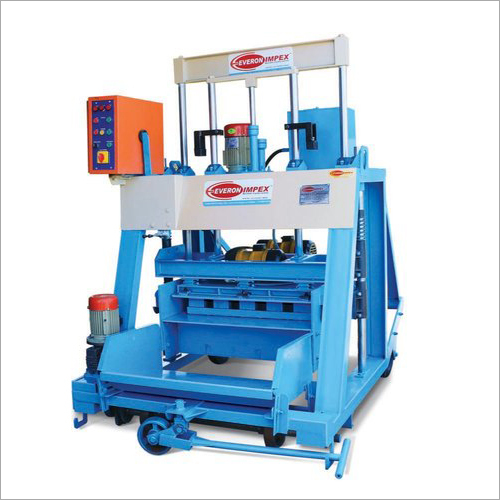
Heavy Duty Hollow Block Making Machine
Hollow cement blocks are different from solid blocks, by the presence of one or more hollow cores. Hollow cores in the blocks reduce their cross-sectional area and weight. The insulation of the blocks with hollow cores also improves. These blocks can be made in cubicle and rectangular shapes with one core and two cores, respectively. These blocks can be made in our Heavy Duty Hollow Block Making Machine.The heavy duty, low maintenance machine can be used for producing hollow blocks, as well as paver and solid blocks. The operator only has to change the moulds. This machine will produce high strength, high density hollow blocks, made using material, like cement, sand, gravel and water.
Specification
| 1119 AUTOFEEDER MODEL | TRIPLE VIBRATOR |
| Total Power | 9 H P |
| `3 Phase 415 V | |
| Hydraulic Motor | 5 H.P 1440 rpm |
| Vibrator Mould Motor | 2 H.P 2880 rpm |
| Vibrator Ram Motor | 1 H.P.2880 rpm |
| Travel Motor | 1 H.P 1440 rpm |
| Weight | 2150 kg (Approx) |
| Operating Pressure | 140 kg/cm³ |
| Method | Hydraulic Pressure |
| Warranty | 1 Year |
| Condition | New |
| Motor Make | Kirloskar/Crompton/Havells |
| Hydraulic Cylinders | 4 |
| Hydraulic Tank | 25 Litres |
| Material | Mild Steel Vizagukku Brand |
| Block Type | Solid/Hollow |
| Interchangablemould | Yes |
| Production capacity 50-60 stroke/hour | 400 x 200 x 100 mm 10 blocks/stroke |
| Size | 400 x 200 x 150 mm 06 blocks/stroke |
| Automation | 400 x 200 x 200 mm 05 blocks/stroke |
| Usage | 300 x 200 x 100 mm 12blocks/stroke |
| Production Capacity | 300 x 200 x 150 mm 09 blocks/stroke |
| Power Motor | 300 x 200 x 100 mm 08 blocks/stroke |
Superior Block Production CapacityThis heavy-duty machine offers exceptional output, manufacturing up to 1500 blocks per hour with each stroke producing five blocks. It supports both hollow and solid brick types, ensuring flexibility for various construction requirements. The mould cycle time ranges from 20 to 25 seconds, optimizing productivity while maintaining consistent block quality.
Robust Hydraulic and Vibration SystemsFeaturing a powerful 60 KN hydraulic pressure and a dedicated 2 HP vibration motor, this block making machine guarantees well-compacted blocks with uniform density. The water-cooled system prolongs machine life and ensures reliable operation under diverse temperature conditions from 0C to 50C.
FAQs of Heavy Duty Hollow Block Making Machine:
Q: How does the Heavy Duty Hollow Block Making Machine operate?
A: The machine utilizes hydraulic pressure and a vibration system to compact raw materials such as cement, concrete, or fly ash into moulds. With its semi-automatic control (manual or PLC), operators can manage production efficiently, cycling every 20-25 seconds to produce up to five blocks per stroke.
Q: What types of blocks can be produced using this machine?
A: This equipment is capable of manufacturing both hollow and solid blocks. The moulds are adaptable, allowing users to switch between different block sizes and shapes, depending on project requirements.
Q: Where is installation and support provided for this block making machine?
A: Installation is supported onsite by the manufacturer or supplier, ensuring the machine is set up and calibrated correctly at your production facility. Expert technicians provide assistance and training for smooth operation.
Q: What is the process of block production using this machine?
A: Raw materials (cement, concrete, fly ash) are loaded into the mixing unit. The hydraulic system then compresses the mixture into moulds while the vibration motor ensures proper compaction. Blocks are lifted at a speed of 80-100 mm/sec up to 1200 mm height and are ready for curing after demoulding.
Q: What are the benefits of using this Heavy Duty Hollow Block Making Machine?
A: Users benefit from high productivity, low noise operation, and long-term durability due to its robust construction and corrosion-resistant surface. The water cooling system enhances operational stability, while onsite support and after-sales service provide peace of mind for maintenance needs.
Q: When should preventative maintenance be performed on this machine?
A: Routine preventative maintenance should be conducted based on operational hourstypically after every 1000 hours of use. Regular checks include inspecting hydraulic systems, oil tank levels, vibration motor operations, and cleaning cooling water pathways to ensure consistent machine performance.







 Send Inquiry

